

site search
online catalog
Uniforms & Cloth
Showing 201 to 220 out of 229
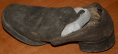
SCARCE INDIAN WAR US ARMY 1872 PATTERN SHOE ALTERED TO CAMP OR BARRACKS SHOE
New pattern shoes and boots were introduced in the U.S. Army in 1872 and in use until the 1880s with a minor change in 1876 to a longer tongue. These shoes improved upon Civil War issue patterns… (1052-286). Learn More »
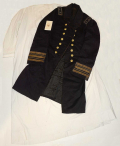
CIVIL WAR COMMODORE’S UNDRESS FROCK COAT OF SILAS H. STRINGHAM, USN: LEADER OF THE FIRST COMBINED OPERATION OF THE UNION NAVY AND ARMY IN THE CIVIL WAR; VICTOR OF THE BATTLE OF HATTERAS INLET BATTERIES
Fought on Aug. 28-29, 1861, little more than a month after the Union defeat at Bull Run, the capture of Forts Hatteras and Clark on the outer banks helped restrict Confederate blockade running,… (1179-504). Learn More »
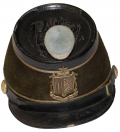
VERY NICE PATTERN 1872 SHAKO WITH MASSACHUSETTS BUTTONS & BOSTON MAKER’S LABEL
Shako is made with a black felt body with a leather crown and base. The black felt body is in very nice condition. Color has faded a bit from black to black with a greenish tint. The leather crown has… (410-503). Learn More »
$595.00
Originally $750.00
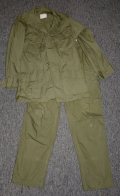
SET OF VIETNAM JUNGLE FATIGUES DATED 1967 & 1971
Coat is made of a green “rip-stop” material with slanted breast pockets and flaps that button down. The flap buttons are not exposed but are covered. There are five green buttons down the front.… (772-92A). Learn More »
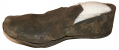
SCARCE CIVIL WAR ISSUE SHOE ALTERED TO CAMP/BARRACKS SHOE
The army did not issue “post,” “barracks,” or “camp” shoes until the 1880s. Before that it was up to soldiers to privately purchase or improvise footwear that might prove more comfortable… (1052-426). Learn More »
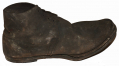
SCARCE INDIAN WAR US ARMY 1872 PATTERN SHOE WITH FIELD REPAIR
New pattern shoes and boots were introduced in the U.S. Army in 1872 and in use until the 1880s. These shoes improved upon Civil War issue patterns mainly by using brass screws in the soles, rather… (1052-576). Learn More »
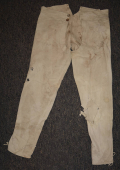
VERY RARE CIVIL WAR U.S. ARMY ISSUE DRAWERS
Civil War army-issue undergarments are extremely rare. They were made and issued in huge numbers, but were characteristically cheaply made, often disliked, and hardly worth preservation as a cherished… (1052-255). Learn More »
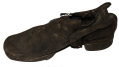
“FORTY MILES A DAY ON BEANS AND HAY IN THE REGULAR ARMY-O” SCARCE INDIAN WAR US ARMY 1872 PATTERN SHOE FROM FORT PEMBINA, N.D.
New pattern shoes and boots were introduced in the U.S. Army in 1872 and in use until the 1880s. These shoes were similar to Civil War issue patterns, with square toe, rough-side out black leather… (1052-292). Learn More »
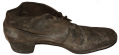
EARLY BARRACKS OR CAMP SHOE BY JOHN MUNDELL OF PHILADELPHIA
This is a usual soldier’s shoe from Fort Pembina, ND, a small U.S. army post from 1870 to 1895, and is typical army construction using rough-side out black leather and is clearly stamped “J.… (1052-388). Learn More »
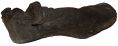
SCARCE INDIAN WAR US ARMY 1872/76 PATTERN CAVALRY BOOT FROM FORT PEMBINA, N.D.
This scarce Indian War U.S. cavalry boot actually comes from Fort Pembina, a small U.S. Army frontier fort in North Dakota in operation from 1870 to 1895. The army introduced new shoe and boot… (1052-304). Learn More »
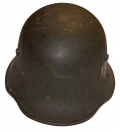
SINGLE DECAL AUSTRIAN MODEL 1916 TRANSITIONAL HELMET FOR USE IN WORLD WAR TWO
This helmet began life as an “apple green” Model 1916 helmet. Then, under the Nazis it was painted field gray, had a new liner and chinstrap added and a single army eagle decal attached to the… (2023-2359). Learn More »
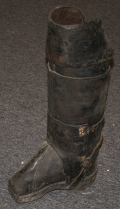
RARE POSTILION BOOT WITH SPUR
A postilion was a man who rode one of a pair of horses that pulled a coach or artillery piece. It could be very dangerous if a leg became caught between the two horses, so each postilion wore one boot… (1032-176). Learn More »
$1,200.00
Originally $1,500.00
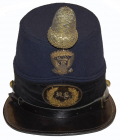
HIGH QUALITY REPRODUCTION MODEL 1855 GENERAL OFFICERS SHAKO WITH ORIGINAL PERIOD INSIGNIA
Shako has a high pasteboard body covered in dark blue wool at the top with a band of black wool around the base of the crown. The shako body stands 7.25 inches high with a disk in the crown that meas.… (2023-280). Learn More »
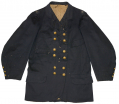
UNION CAVALRY GENERAL WILLIAM WELLS’ FIELD BLOUSE: MEDAL OF HONOR FOR GETTYSBURG WHERE HE RODE IN THE LEAD OF FARNSWORTH’S CHARGE; BRIGADE COMMANDER UNDER CUSTER; BLOUSE ACTUALLY WORN IN ONE OF HIS PHOTOS
This coat is the epitome of a Civil War Union general’s field uniform, a blouse following the popular sack coat pattern of the period, looking somewhat like an enlisted man’s fatigue blouse and… (1179-281). Learn More »
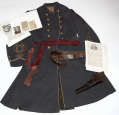
MISSOURI CONFEDERATE FROCK COAT, SASH, CS SWORD BELT, AND HOLSTER, OF MAJOR WILLIAM F. HAINES, WITH FAMILY ARCHIVE OF PHOTOS & PAPERS: SHILOH, VICKSBURG, AND NEGOTIATIONS WITH SHERMAN FOR SURRENDER OF GEN. L.S. BAKER’S COMMAND IN APRIL 1865
This beautiful, identified Confederate major’s coat, sash, sword belt, sash, and holster, once in the Texas Civil War Museum, comes with two brown ink notes that were pinned to it, one reading:… (1179-277). Learn More »
$75,000.00
ON HOLD
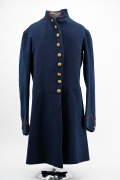
VERY NICE BOYLAN CONTRACT MARKED CIVIL WAR HEAVY ARTILLERY ENLISTED MAN’S FROCK COAT: THESE REGIMENTS WERE CALLED INTO THE FIELD AS INFANTRY FOR GRANT’S 1864 OVERLAND CAMPAIGN AGAINST RICHMOND AND PETERSBURG
This Civil War U.S. regulation enlisted man’s frock coat for heavy (or “foot”) artillery is in very good condition, with strong color to the body and piping, and is nicely marked in the upper… (172-5915). Learn More »
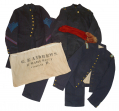
FANTASTIC UNIFORM GROUPING OF G.E. ANDREWS: OFFICER’S FROCK COAT, OFFICER’S SHORT JACKET, OFFICER’S TROUSERS, AND HIS TAILOR-MADE FIRST SERGEANT FROCK COAT WITH VETERAN SERVICE STRIPES!
We don’t often use exclamation points in a description, but this identified uniform grouping, formerly in the collections of the Texas Civil War Museum, has not just historical interest, but… (1179-147). Learn More »
$24,000.00
ON HOLD
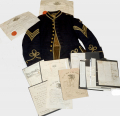
RARE IDENTIFIED 65th NY SERGEANT’S JACKET, WITH MANSCRIPT MATERIAL: 1st U.S. CHASSEURS
This is an extremely rare, early-war uniform jacket, with related material, belonging to a sergeant of the 65th New York, who enlisted at the beginning of the war as the regiment’s commissary… (1179-233). Learn More »
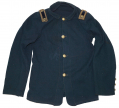
6th MICHIGAN CAVALRY ID’D CAPTAIN’S FATIGUE BLOUSE: CAPT. WILLIAM HYSER, MICHIGAN CAVALRY BRIGADE
Formerly in the collections of the Texas Civil War Museum, this wonderful Civil War officer’s fatigue coat belonged to Captain William Hyser, who served twice as a Captain in the 6th Michigan… (1179-170). Learn More »
$15,000.00
ON HOLD
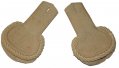
PAIR OF REGULATION 1851 BUFF EPAULETTES - HORSTMAN MARKED
These buff cloth epaulettes are in very good condition with only light surface dirt from age and storage throughout. There is no damage of any kind. The body of each is covered in a buff colored cloth… (37-386). Learn More »
$350.00
Originally $550.00
Showing 201 to 220 out of 229
Most Popular
Historical Firearms Stolen From The National Civil War Museum In Harrisburg, Pa »
Theft From Gravesite Of Gen. John Reynolds »
Selection Of Unframed Prints By Don Troiani »
Fine Condition Brass Infantry Bugle Insignia »
Rare Identified 65Th Ny Sergeant’s Jacket, With Manscript Material: 1St U.s. Chasseurs »
featured item
APPOMATTOX PAROLE OF LT. DAVID BEAM HARRILL COMPANY B 34th NORTH CAROLINA: PICTURED IN UNIFORM IN MAST VOLUME 1: NC STATE TROOPS AND VOLUNTEERS
This comes from the collection of Greg Coco, scholar and author of an article on Appomattox paroles in the March-April 2006 issue of Civil War Times that deals with the circumstances of the printing of these paroles, their importance to paroled… (1300-64). Learn More »
site search