

site search
online catalog
AMES STAFF & FIELD OFFICERS SWORD PRESENTED TO ISAAC HUGHES ELLIOTT 33RD ILLINOIS: WIA, CAPTAIN, MAJOR, LT. COLONEL, COLONEL & BREVET BRIGADIER GENERAL
Hover to zoom
$3,500.00 ON HOLD
Quantity Available: 1
Item Code: 1268-212
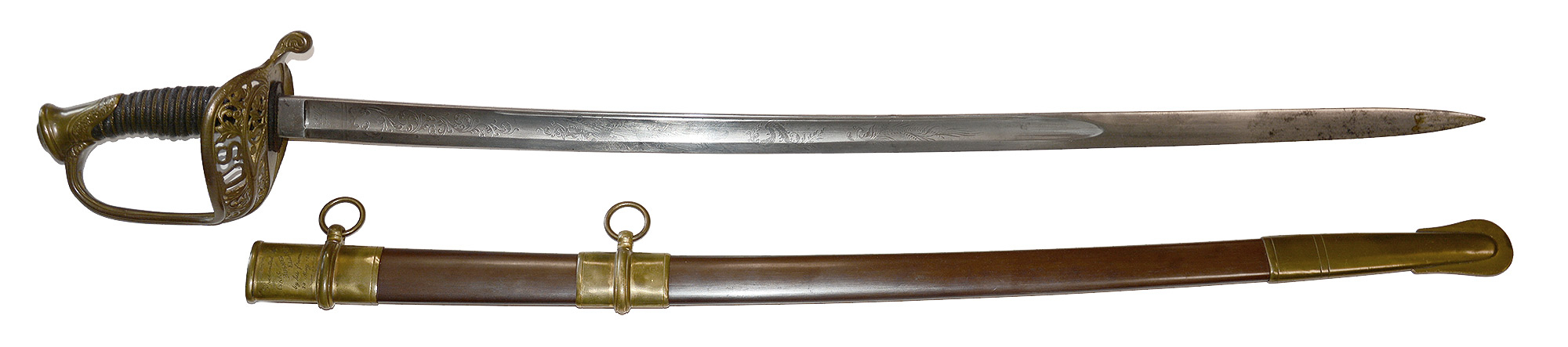
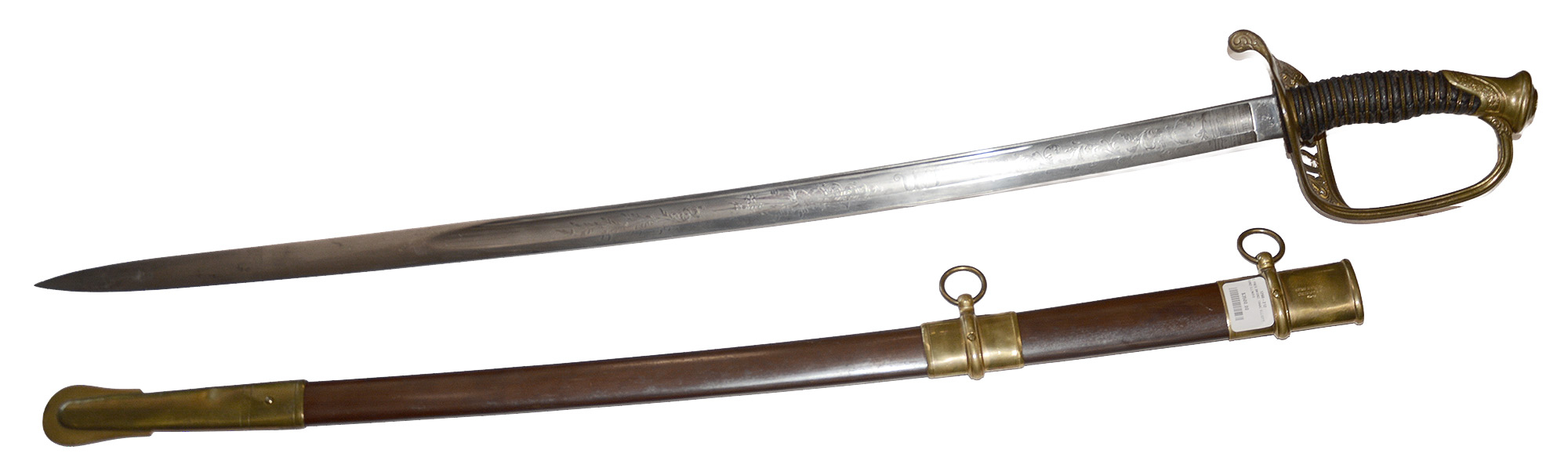
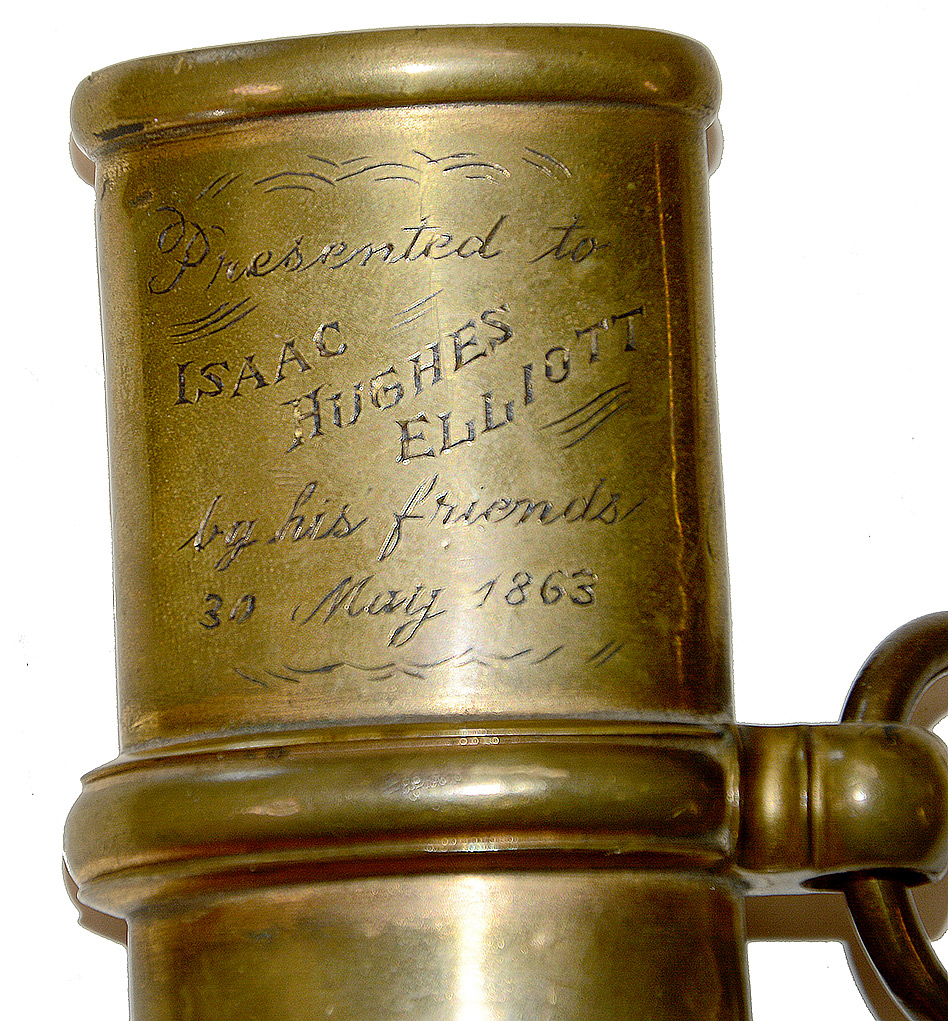
This is a great looking sword in very good condition, presented mid-war to an officer with an active service and combat record, promoted several times in field grade and breveted Brigadier General of Volunteers as of March 13, 1865, “for gallant and meritorious services in the battles of Port Gibson, Champion Hills, Black River Bridge, Siege of Vicksburg, and Spanish Fort.” The presentation is on the obverse of the scabbard upper mount and reads in a mix of script and block letters with flourishes: “Presented to / ISAAC HUGHES ELLIOTT / by his friends / 30 May 1863,” the date being his official date of rank and muster as Major of the 33rd Illinois, replacing L.H. Potter, who had moved up to Lt. Colonel effective May 29.
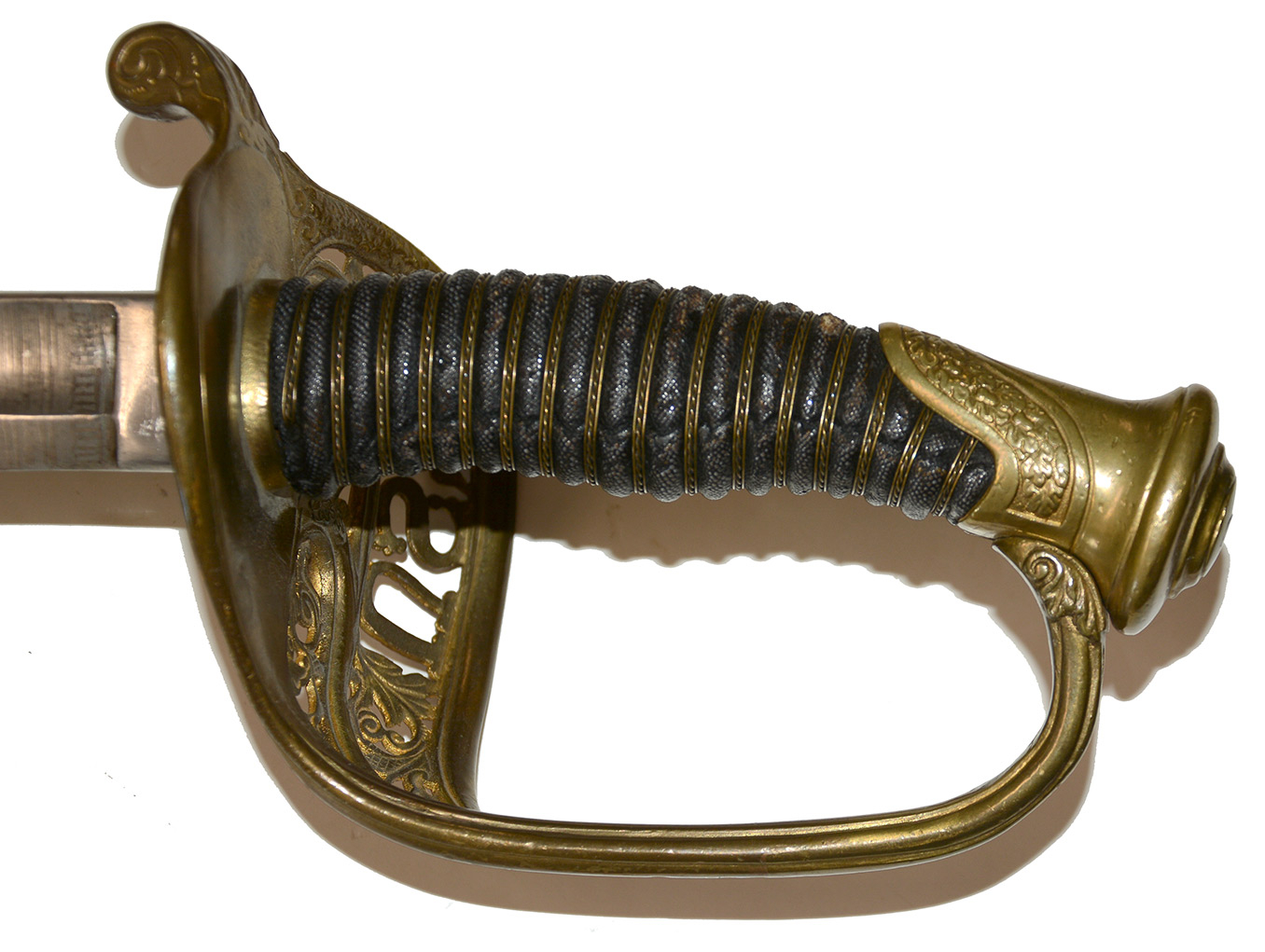
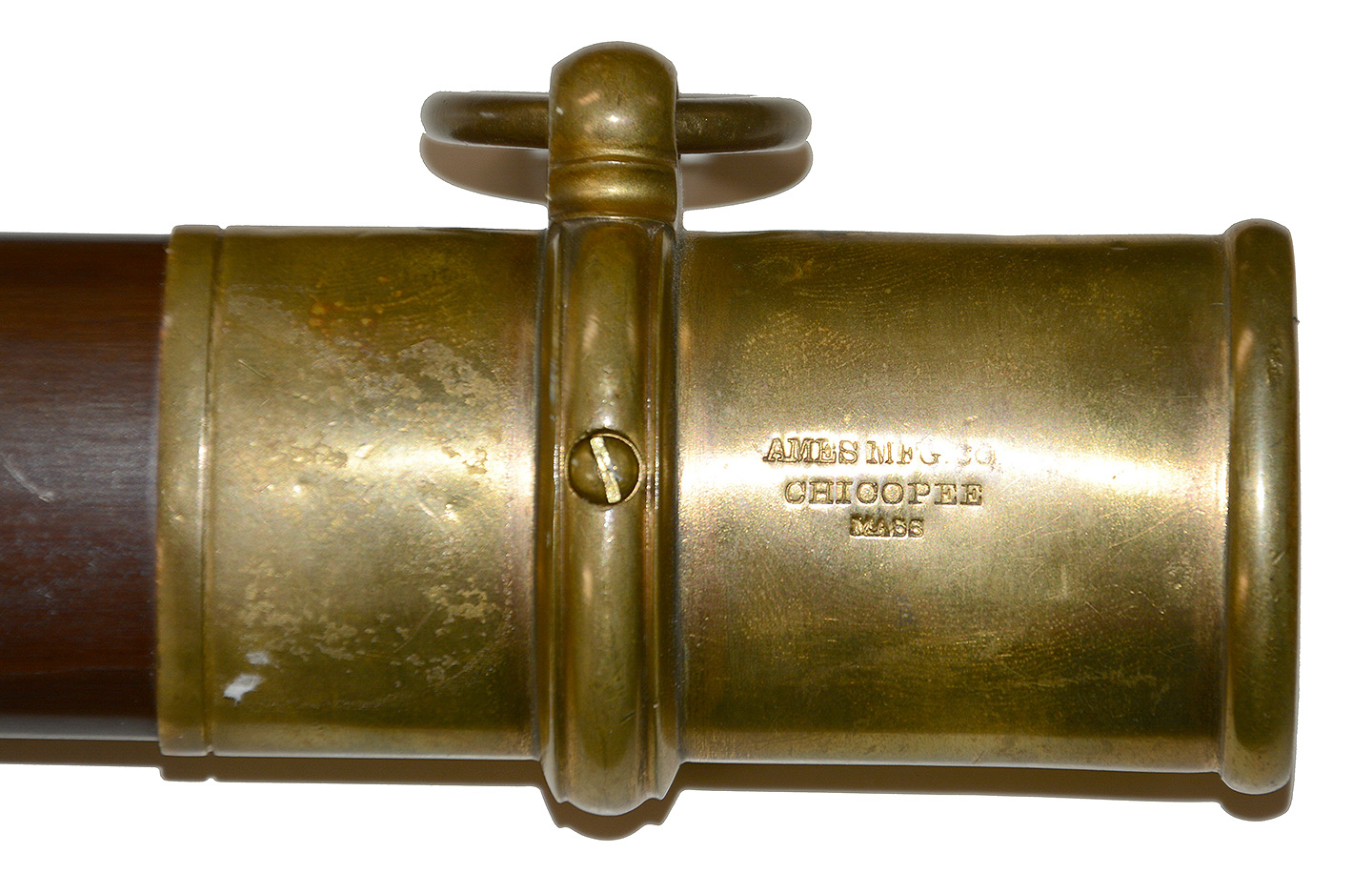
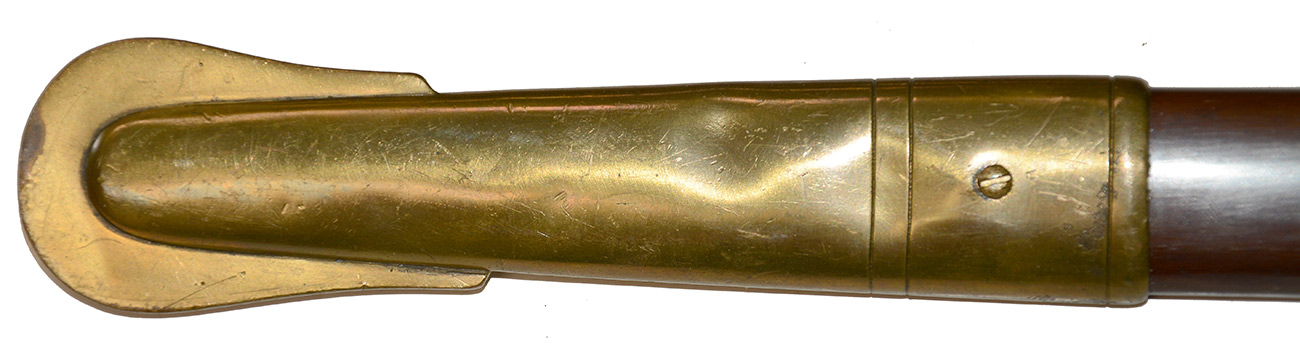
The sword is a U.S. Model 1850 Staff and Field Officer’s sword, regulation for majors and above, made by Ames, the best known American sword maker of the Civil War. It is complete and in very good condition, with the brass bright but not polished, still showing some gilt in recesses, with no bends, breaks or stains. The blade has a good edge and point, and the etching is only slightly muted by age, completely visible against the frosted ground. The scabbard preserves a smooth, rich brown finish to the body, with no dents or dings, and the brass mounts have a patina matching the hilt and show only a couple of minor dings on the drag. Both sword and scabbard are nicely marked by Ames: etched on the sword blade and stamped on the reverse of the upper scabbard mount.
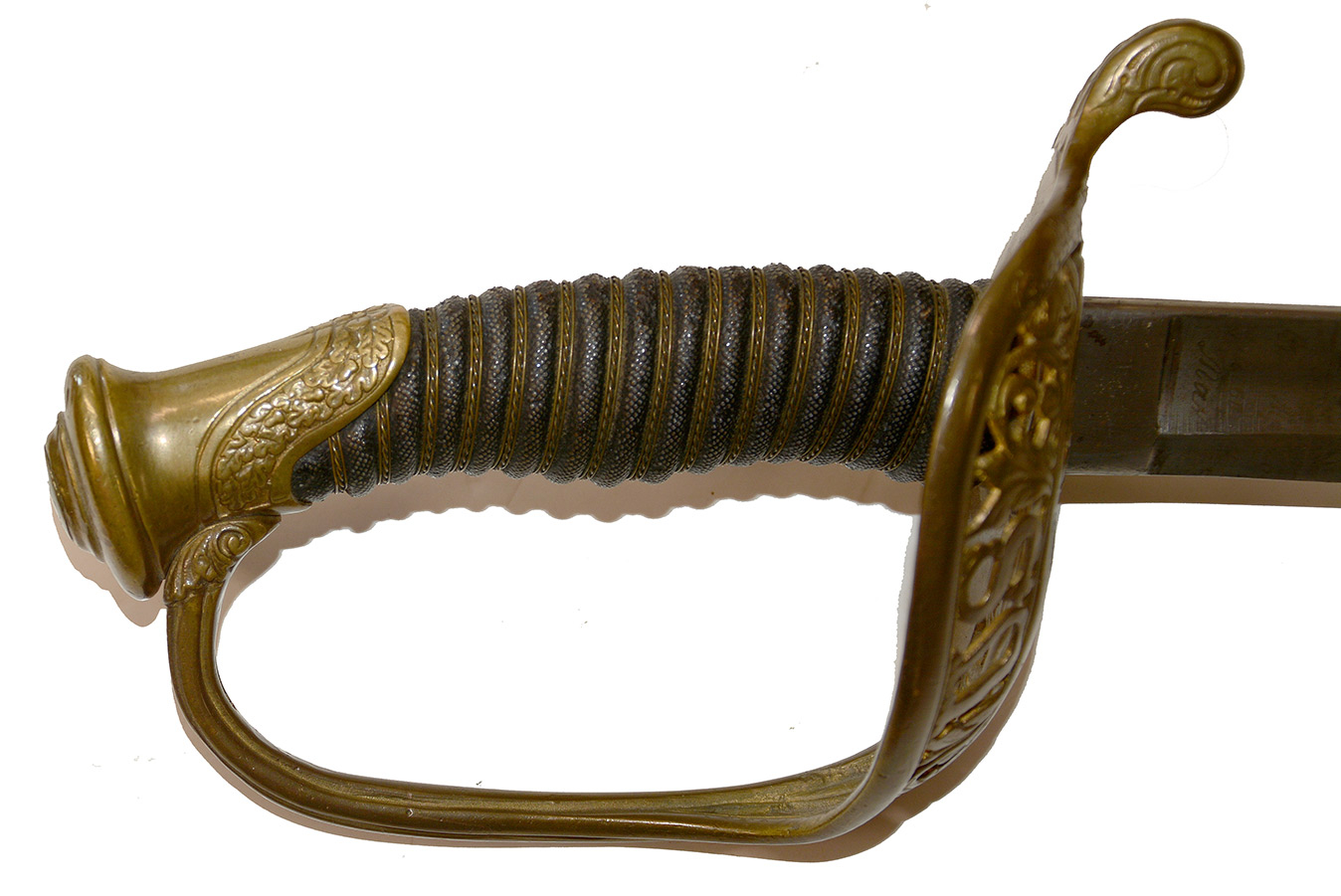
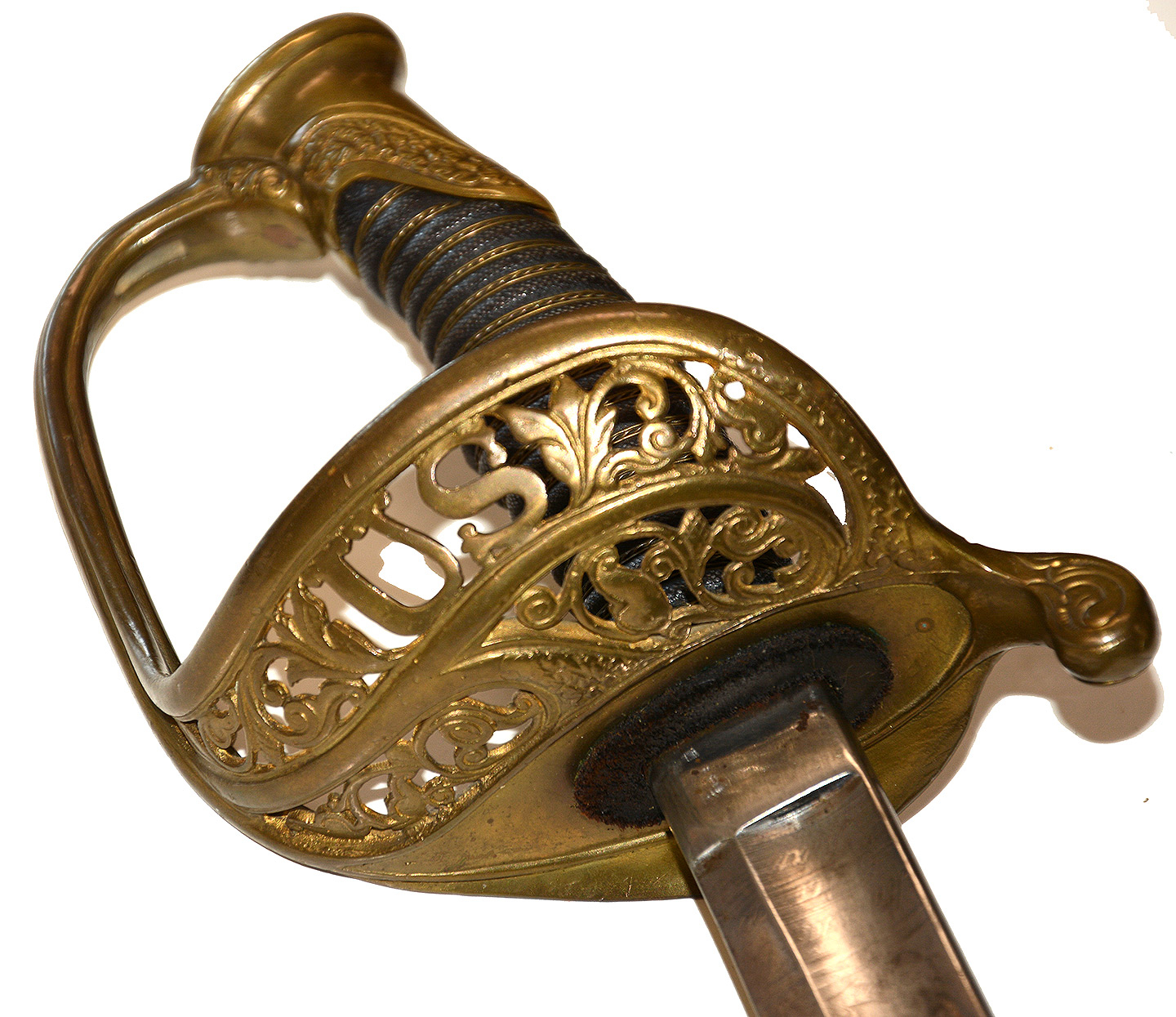
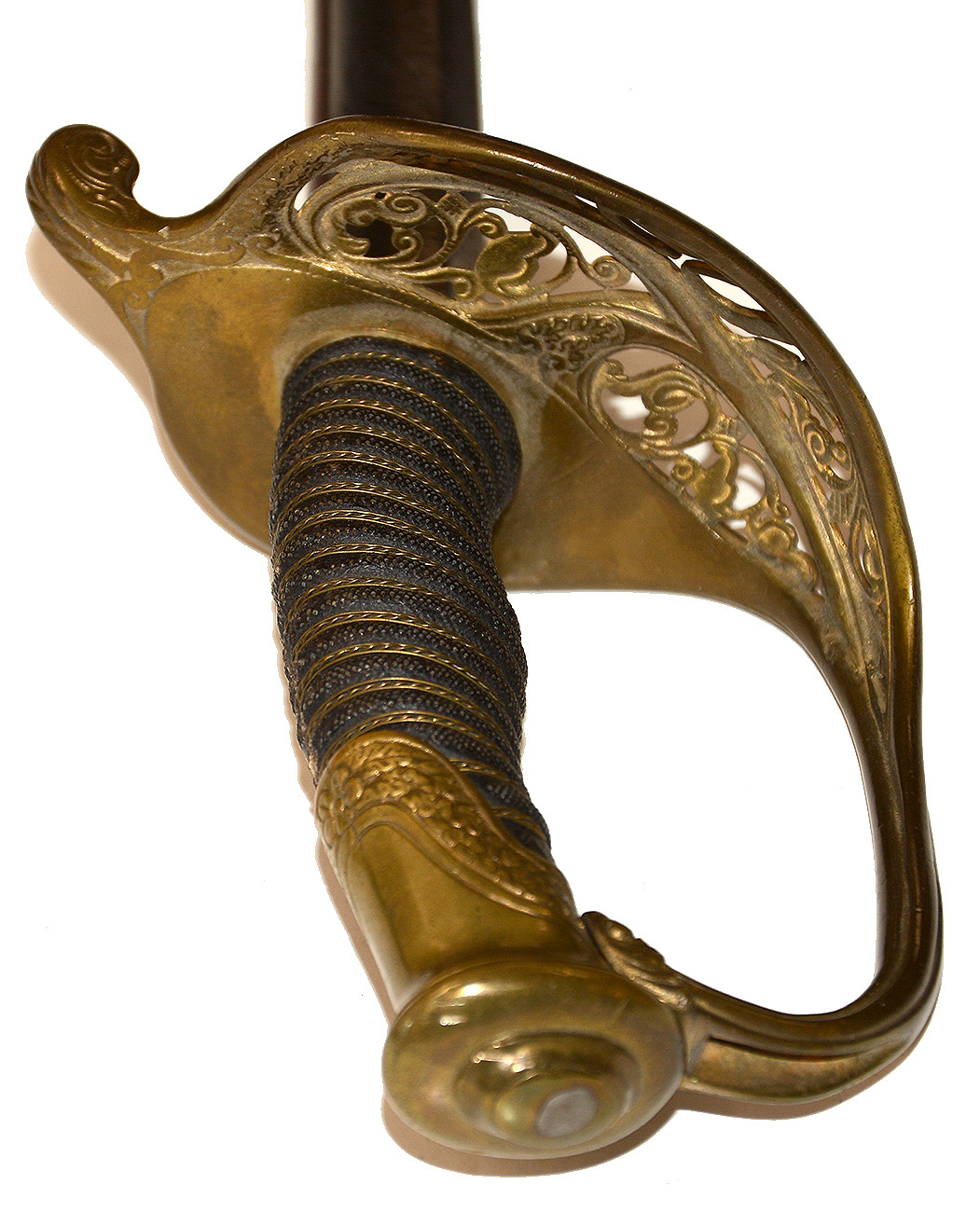
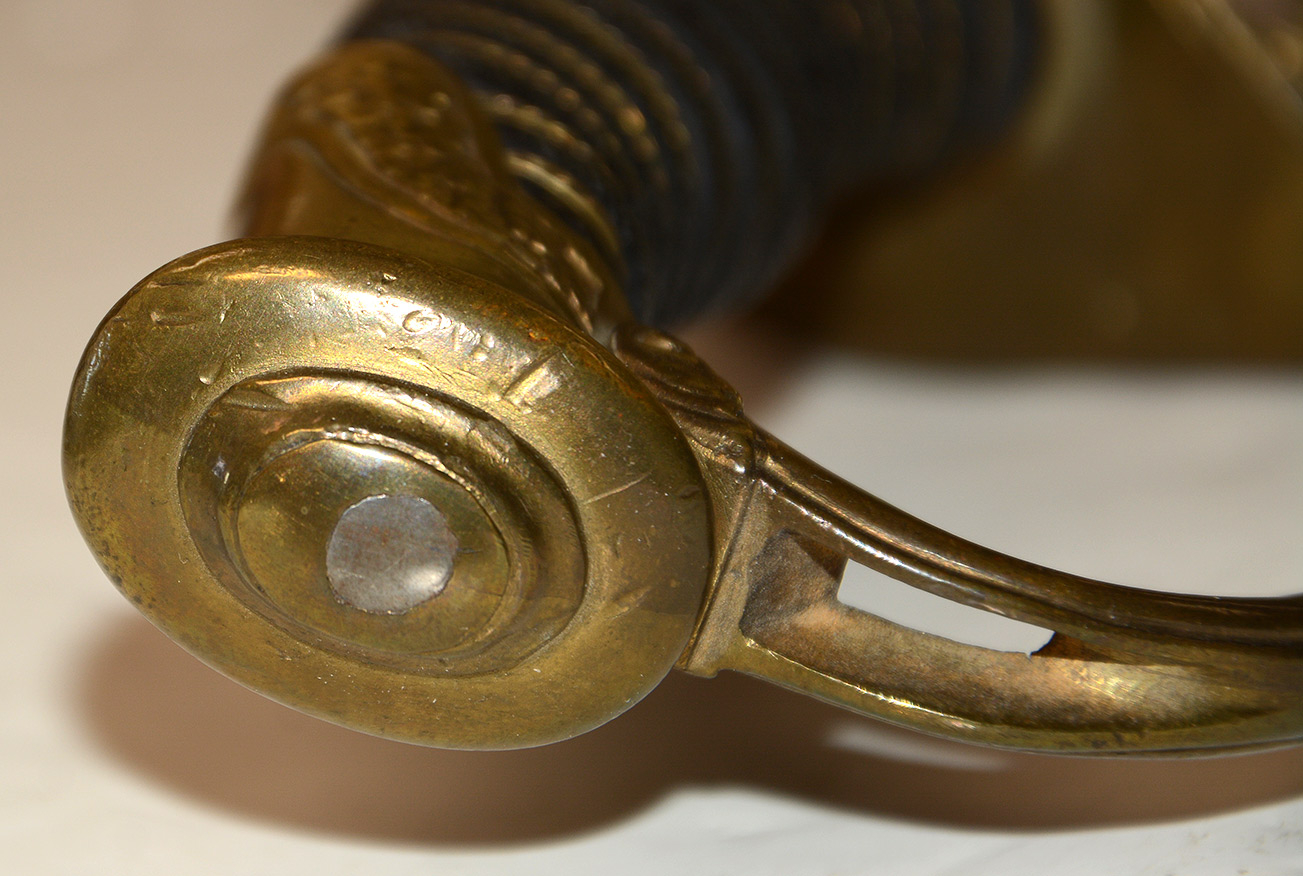
The pommel bears a recessed band of oakleaf and acorn decoration cast and chased around its lower edge, with the knucklebow showing some foliate scrolls underneath the pommel and transitioning into integral branches in the openwork guard that bears foliate scrolls between the branches and a large floating “US,” with the branches bearing short cast and chased foliate motifs as they join the counterguard and quillon, which has a scroll finial. The grip is bound in gray shark/ray skin with excellent surface showing just a few tiny wear spots and retaining its full gilt brass triple wire binding. The blade pad is present on the underside of the guard.
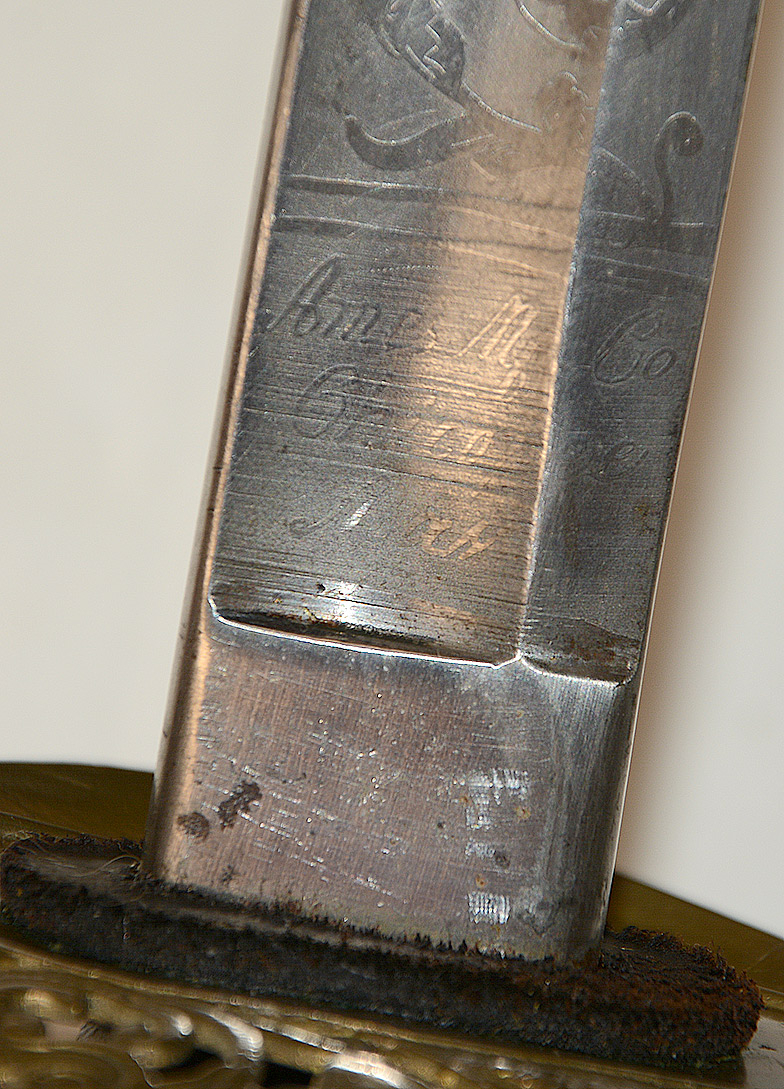
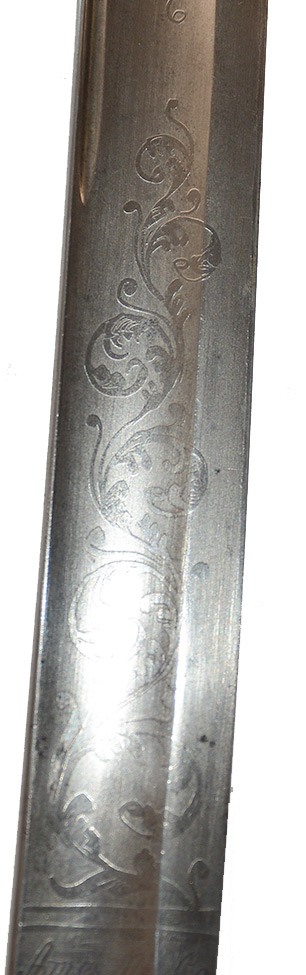
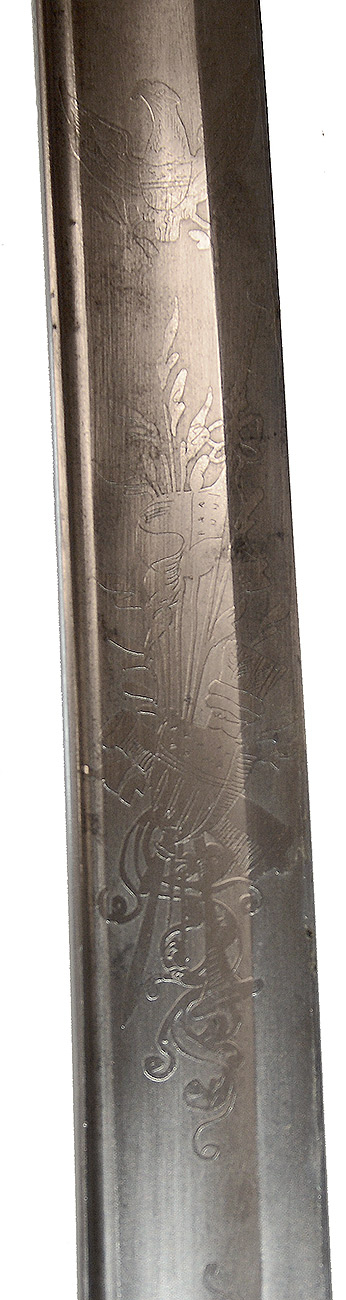
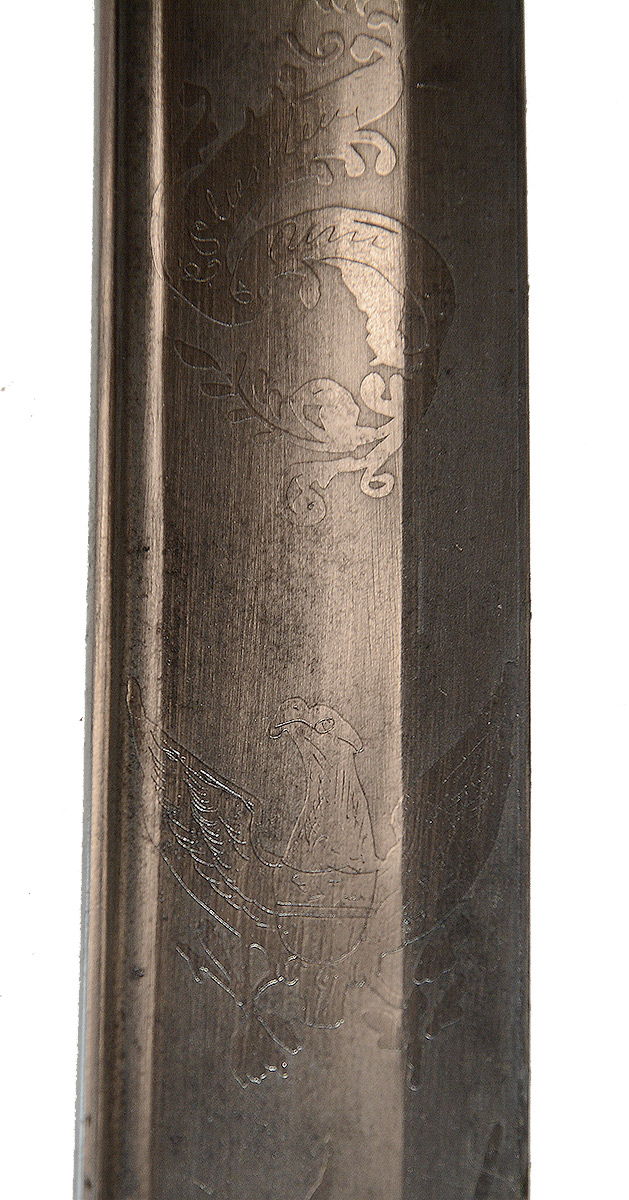
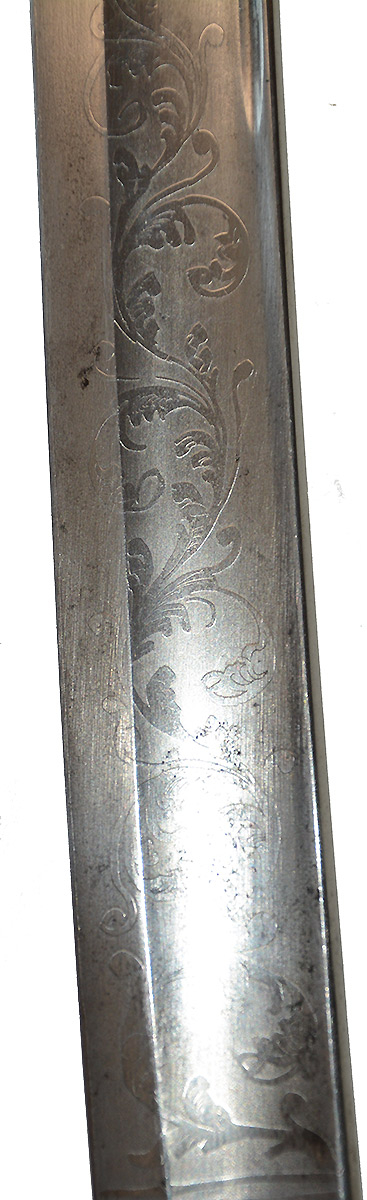
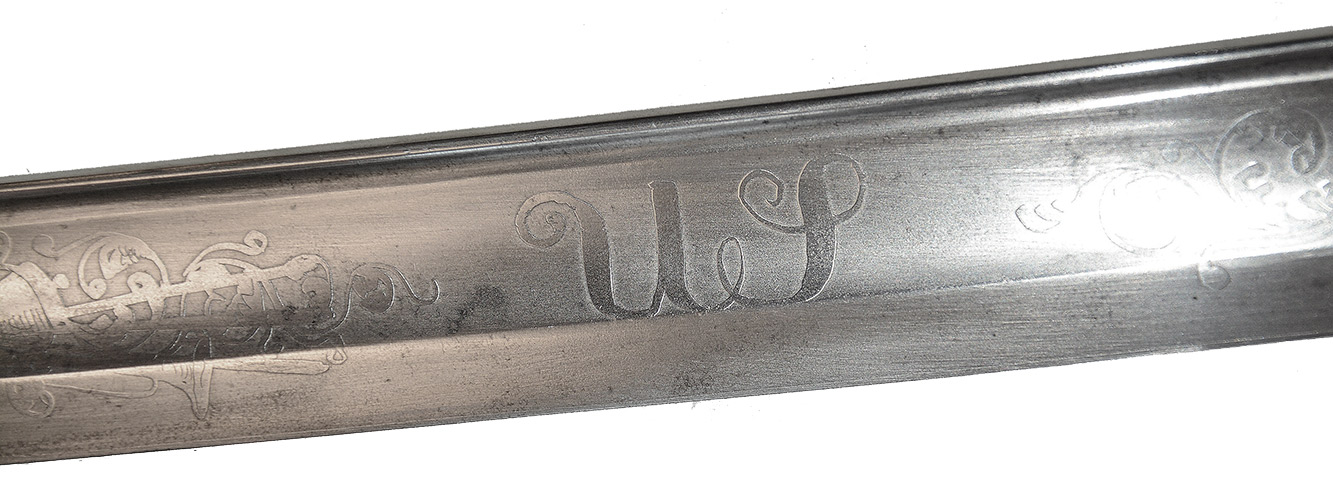
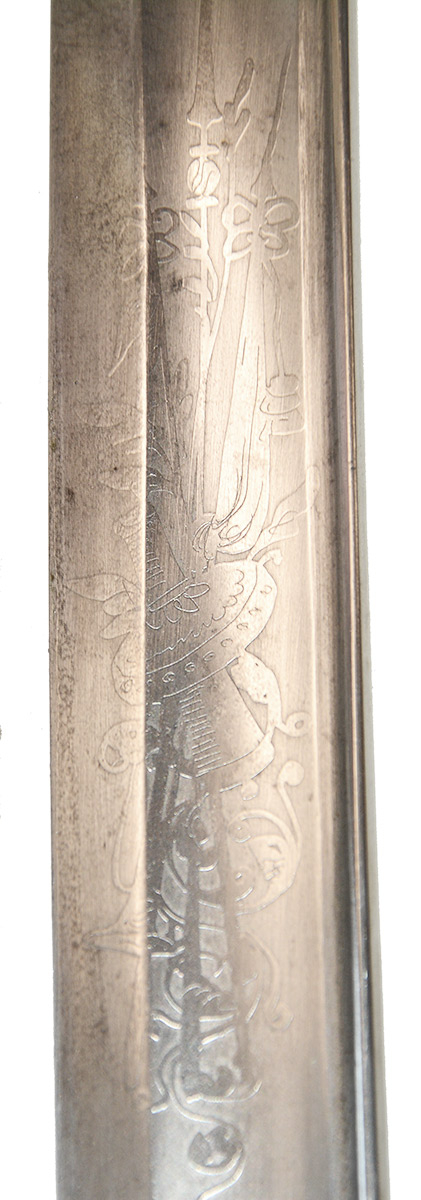
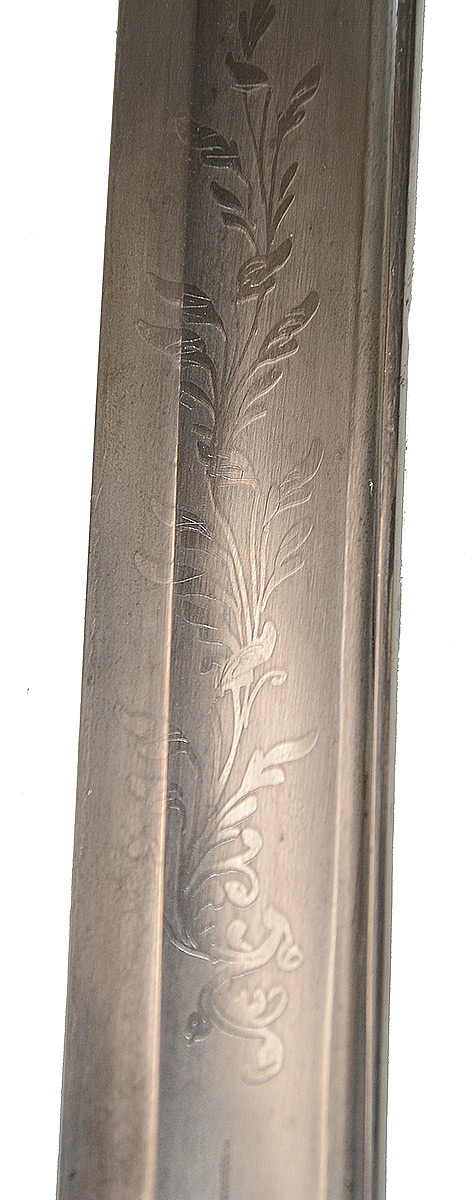
The blade etching extends about 2/3 of its length, nearly to the end of the fuller. The obverse is etched at bottom, just above the ricasso, with the Ames address: “Ames Mfg. Co. / Chicopee / Mass.” with just some rubbing on the bottom line. A line of loose foliate scrolls extends up from this, over which a vine entwined stand of arms is followed by a US eagle with raised wings, US shield on its chest, holding arrows and olive branch, with an E PLURIBUS UNUM foliate ribbon scroll overhead, the etching concluding with a long leafy vine and foliate spray. The reverse uses similar, open foliate scrolls at the bottom, followed by a script US. Over this is a tall stand of arms consisting of pikes, banners, cannon, bugle, etc., with the etching terminating with long leafy fine and foliate spray like the obverse.
The scabbard is complete, with upper and middle ring mounts with rings, and drag in place. The drag showing only some light dings, typical of a sword with any use. Both the Ames maker’s stamp and engraved presentation are fully legible on the upper mount.
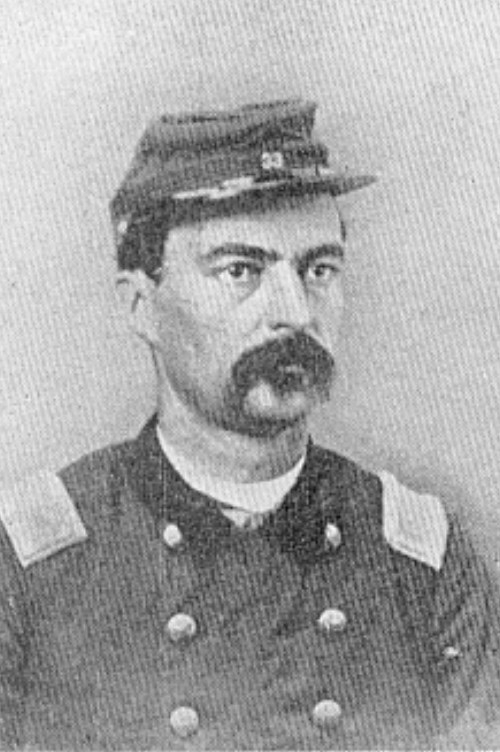
Isaac Hughes Elliott was born in Bureau County, Illinois, in 1837, but attended college at the University of Michigan, where he was a member of the Class of 1861. He followed the advice of the university’s President to the students to return home and enlist. Graduating in June, 1861, he returned to Illinois, enlisting August 19, 1861, mustering in as Captain of Co. E, 33rd Illinois, as of Sept. 2. He was described as 6-feet tall with a dark complexion, black hair and black eyes. The University of Illinois was well represented in the regiment, earning the regiment the nickname of the “Teachers’ Regiment,” among others.
The regiment moved to Missouri in late September and later to Arkansas. They took part in several scouting expeditions early on and on October 15 Elliott’s company was posted as a guard at Big River Bridge on the Iron Mountain Railroad when they were attacked and overwhelmed, with Elliott wounded, in the arm according to one source, and captured in the fighting. He labored to obtain a parole and exchange for himself and his men, the parole being effected Nov. 1, 1861, for himself, another officer and 54 enlisted men, and the exchange and return to duty taking place in early February 1862 at Cairo, Il, in time to take part in the regiment’s move into Arkansas about March 1. There they took part in the battle of Cache Creek, (a.k.a. Cache Bayou or Cotton Plant) in July, tangling with Texas Rangers and recapturing a field piece lost by Union cavalry. During the rest of July and August they camped about 20 miles south of Helena, participated in eight expeditions up and down the river, moving then to Sulphur Springs and Pilot Knob in October before taking part in a mid-winter campaign in southeast Missouri.
In March 1863 they departed for Milliken’s Bend, La., joining the 13th Corps for the Vicksburg Campaign. They were in reserve at the Battle of Champion Hills on May 16, but took part in the pursuit and on May 17 were in the advance and in the charge at Black River Bridge were the first to seize 14 of the 17 Confederate artillery pieces captured. They arrived at Vicksburg May 19, engaging in sharpshooting from the trenches, and on May 22 six companies took part in the failed grand assault. Elliott’s Company E, 32-strong, was the lead company of the regiment in the attack, losing 11 killed and all the rest wounded except for Elliott himself. They then took part in the siege, lasting six more weeks, with the regiment having already lost 19 killed 102 wounded (10 mortally) by June 1. After the surrender of Vicksburg they helped drive Johnston back to Jackson, returning to the city in late July and moving to New Orleans in August to take part in the Bayou Teche Campaign, and then moving to Arkansas and Texas, taking part in the capture of Fort Esperanza, giving control of Matagorda Bay.
The regiment reenlisted as veterans in early 1864 and in April were ordered to New Orleans and then Brashear City in May, companies being assigned as railroad guards to various posts in the District of Lafourche. On March 2, 1865, they joined the 16th Corps for the attack on Mobile, and were actively engaged in the siege of Spanish Fort, which defended the city, from March 27 to its capture on April 8. It then marched to Montgomery on April 13, arriving April 25, and then moving to Selma and to Meridan, Miss, in mid-May, and lastly back to Vicksburg, where they were garrisoned until mustering out of service, November 24, 1865, and returning to Camp Butler, Illinois, for final payment and discharge in December.
Elliott likely received the sword sometime soon after the inscribed May 30, 1863, date, though his commission as Major did not officially come through until September. Given on-going casualties in the regiment, an impending promotion to field grade was obvious, though to what specific post may have yet been uncertain, perhaps explaining why his friends did not include a specific rank. And, in fact, he made Lt. Colonel September 24, 1864, and Colonel, September 30, 1865, before he mustered out November 24. His brevet to Brigadier General was granted in December, but with an effective date of March 13, antedating his promotion to Colonel.
Elliott’s writings and mention of him make it clear he was self-effacing in general and likely did not mention presentation of this sword out of modesty, and previous experience. He twice mentions the presentation of his “first sword,” which became something of an embarrassment. “At Big River Bridge I lost everything-sword, sash, uniform and all. Just before leaving home I had been presented with a fine sword, sash and belt. The presentation was made at a great gathering of citizens at the Court House. In acknowledging the gift I stated I would ‘never lay down that sword until the Union was saved and every slave set free; that I would bring it back with honor or not come home at all,’ and other statements of like gushing character. It took some nerve to return home inside of six weeks without that sword, or anything else except my trousers.” He was thus clearly being cautious about a second presentation sword, even bringing up the subject of the earlier sword again when he recalled later witnessing a Union cavalry general’s speech accepting a new flag that was soon after lost in the Red River Campaign. The general had made, “even a more bombastic and highfalutin’ speech than I did when my first sword was presented to me, and I imagine his feelings on his return were about the same as mine when I went home after Big River Bridge.” Fortunately, Elliott was able to carry this sword with much better fortune and success on the battlefield.
Elliott returned to Bureau County after the war, farming and serving as County Treasurer 1865-67. He married in 1867, the couple having four children. He tried politics briefly, being nominated as a Liberal Republican candidate for Congress in 1874, but was, in his own words, “very properly defeated.” He maintained some military interests, serving as Illinois Adjutant General 1880-1884, and was active in veterans’ affairs as a member of the Loyal Legion and the veterans’ association of the 33rd Illinois, writing much of their regimental history. In the 1890s he moved to New Mexico, where he continued farming and was a rancher. In a typically self-effacing summary of his farming he stated, "I was born on a farm, always lived on a farm, and always bought and sold at the wrong time." He died at White Plains, NY, in December 1922. The regimental history is available online as is his record in a 1902 history of the University of Michigan Class of 1861 in the Civil War. This is a great sword belonging to an active officer, commander of a regiment with a strong fighting record, and an author with a keen sense of irony and humor. [sr][ph:L]
~~~~~~~~~~~~~~~~~~~~~~~~~~~~~~~~~~~
THIS ITEM, AS WITH ALL OTHER ITEMS AVAILABLE ON OUR WEB SITE,
MAY BE PURCHASED THROUGH OUR LAYAWAY PROGRAM.
CLICK HERE FOR OUR POLICIES AND TERMS.
THANK YOU!
Inquire About AMES STAFF & FIELD OFFICERS SWORD PRESENTED TO ISAAC HUGHES ELLIOTT 33RD ILLINOIS: WIA, CAPTAIN, MAJOR, LT. COLONEL, COLONEL & BREVET BRIGADIER GENERAL
Most Popular
Historical Firearms Stolen From The National Civil War Museum In Harrisburg, Pa »
Theft From Gravesite Of Gen. John Reynolds »
Selection Of Unframed Prints By Don Troiani »
Fine Condition Brass Infantry Bugle Insignia »
Rare Identified 65Th Ny Sergeant’s Jacket, With Manscript Material: 1St U.s. Chasseurs »
featured item
IMPORT MODEL 1850 CIVIL WAR FIELD & STAFF OFFICER’S SWORD ID’D TO COL. RICHARD M. CORWINE, MEMBER OF GENERAL FREMONT’S STAFF
Original Civil War Model 1850 Field & Staff officer’s sword in nice condition complete with its metal scabbard. Sword is unmarked and is no doubt an import item. It is identified by a presentation inscription to R. M. Corwine, Aide-de-camp to… (870-157). Learn More »
site search