

site search
online catalog
Cartridges & Gun Tools
Showing 101 to 120 out of 128
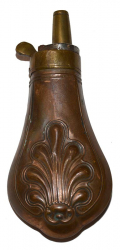
SMALL PISTOL POWDER FLASK
This is very small powder flask, possibly of European manufacture and perhaps made on contract for an American retailer, intended for a pocket revolver or small single shot pistol. Measures… (490-5247). Learn More »
BULLET MOLD FOR .31 CALIBER REVOLVER
Iron, two cavity bullet mold for the .31 caliber revolver. It casts one round ball and one elongated bullet. There is no sprue cutter. Cavities remain clean and crisp. There are several small dings on… (490-4365). Learn More »
BULLET MOLD FOR .31 CALIBER REVOLVER
Iron, two cavity bullet mold for the .31 caliber revolver. It casts one round ball and one elongated bullet. There is no sprue cutter. There are several small dings on exterior where the mold needed… (490-4364). Learn More »
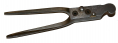
BULLET MOLD FOR .31 CALIBER (120 GAUGE) ADAMS REVOLVER
Brass, two cavity bullet mold for 120 gauge (approx. .31 caliber) English Adams revolver. It casts two elongated bullets. These feature a pointy nose, two grooves, and a solid base. Iron sprue cutter… (490-4378). Learn More »
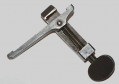
M-1855 MAINSPRING VISE FOR CONVERSION MUSKETS
Mainspring vise for the many types of early muskets that were converted to percussion ignition. Typical vise mechanism with offset bar to accommodate the older flintlock mainsprings. Excellent… (490-4363). Learn More »
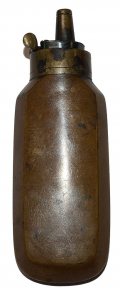
PLAIN PISTOL POWDER FLASK
Constructed with plain copper body and brass top. Funnel unscrews and spring still works. Measures approximately 4.5" tall x 1.5" wide x 1" thick. All surfaces are unadorned, with sides that have… (490-4416). Learn More »
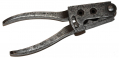
BULLET MOLD FOR .45 CALIBER, COLT M1878 REVOLVER
Iron, two cavity bullet mold for the .45 caliber Colt Model 1878 revolver. It casts two elongated bullets with grooves. These are the “.45 Long Colt” bullets. Sprue cutter is attached to the top… (490-4399). Learn More »
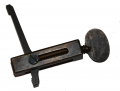
M-1855 MAINSPRING VISE FOR CONVERSION MUSKETS
Mainspring vise for the many types of early muskets that were converted to percussion ignition. Typical vise mechanism with offset bar to accommodate the older flintlock mainsprings. Excellent… (490-4380). Learn More »
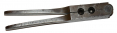
RARE BULLET MOLD FOR .31 CALIBER "WELLS FARGO" M-1849 COLT REVOLVER
Very rare iron, two cavity bullet mold for the .31 caliber "Wells Fargo" Colt revolver. It casts one round ball and one elongated bullet. There is no sprue cutter. Marked "COLT'S / PATENT" across the… (490-4400). Learn More »
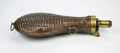
DIXON & SON MARKED POWDER FLASK
This is a pretty powder flask with an adjustable spout and brown lacquered body impressed with a basket weave design on the faces and leaves curling up on either edge, with small brass suspension… (1184-74). Learn More »
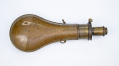
HAWKSLEY MARKED POWDER FLASK
Good condition, plain body powder flask with prominent edge seam and adjustable spout measured in drams. Stamped “G.& J.W. HAWKSLEY / SHEFFIELD” on the top of the collar. Constructed with… (1184-71). Learn More »
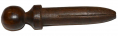
TOMPION FOR BURNSIDE CARBINE
A wood tompion for a cavalryman’s .54 caliber Burnside carbine. This has the characteristic ball top, pointed tip, and cruciform slotted body of the Burnside tompions. They are occasionally seen in… (490-3945). Learn More »
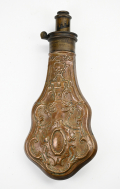
HAWKSLEY POWDER FLASK
This has a wonderful profusion of design elements that seems to combine rococo foliate C-scrolls symmetrically arranged with some geometric ornaments- something in the “too much is not enough”… (1184-75). Learn More »
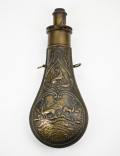
HAWKSLEY POWDER FLASK
A nicely decorated sportsman’s powder flask decorated in two panels with a hunting dog at top and the hunter’s prey at bottom: two stags with prominent antlers standing over a row of five less… (1184-73). Learn More »
DEVELOPMENT OF THE PAPER-WRAPPED MUSKET CARTRIDGE IN COLONIAL AMERICA, 1640-1841
Brown, Rodger. 2022. Hardback, 6 x 9 ¾”. 96 pages; numerous b&w photos and illustrations. During the Revolutionary War, both armies in the conflict were armed with muzzleloading smoothbore… (ST501205). Learn More »
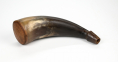
SMALL HUNTER’S POWDER HORN
This horn dates roughly 1820-1850. It is a plain, working powder horn only about 5 ¼ inches long, a size sometimes thought to be just for priming powder for a flintlock, but convenient enough to be… (1184-79). Learn More »
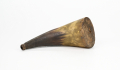
SMALL HUNTER’S POWDER HORN
This horn dates roughly 1820-1850. It is a plain, working powder horn only about 5 3/4 inches long, a convenient size for pocket or hunting bag. Sometimes considered a small horn just for priming… (1184-77). Learn More »
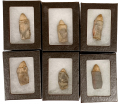
“DUG” .50 CALIBER SMITH “RUBBER CASE” CARTRIDGES
Used in the Smith carbine extensively during the early years of the Civil War, we have several specimens of these unusual .50 caliber “rubber case” cartridges in excavated “relic”… (2022-1238). Learn More »
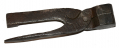
.45 CALIBER IRON PISTOL BALL MOLD & BARREL TOOL
Iron scissor-type mold to cast a lead round ball for revolvers. Measures approximately 3.5” long overall. Single cavity mold with spout. Sprue cutter is formed between the two handles. Cavity… (1164-46). Learn More »
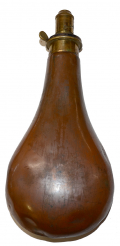
VERY LARGE POWDER FLASK BY J. DIXON & SONS, SHEFFIELD
This very large flask has to have been for shotguns. Constructed with a copper body, with brass top and spout. Measures approximately 11” tall x 5” at widest point. Unadorned body. Thumb tab and… (172-5639). Learn More »
Showing 101 to 120 out of 128
Most Popular
Historical Firearms Stolen From The National Civil War Museum In Harrisburg, Pa »
Theft From Gravesite Of Gen. John Reynolds »
Selection Of Unframed Prints By Don Troiani »
Fine Condition Brass Infantry Bugle Insignia »
Rare Identified 65Th Ny Sergeant’s Jacket, With Manscript Material: 1St U.s. Chasseurs »
featured item
NON-REGULATION SILVER GRIPPED PRESENTATION SWORD BY SCHUYLER, HARTLEY & GRAHAM - LT. JAMES MOFFAT, 16TH NEW YORK CAVALRY
This presentation sword has very impressive deeply cast and chased mounts and silver gripped hilt. Schuyler, Hartley and Graham assembled and sold a wide variety of swords that were often highly embellished and upgraded from regulation patterns, to… (870-653). Learn More »
site search